
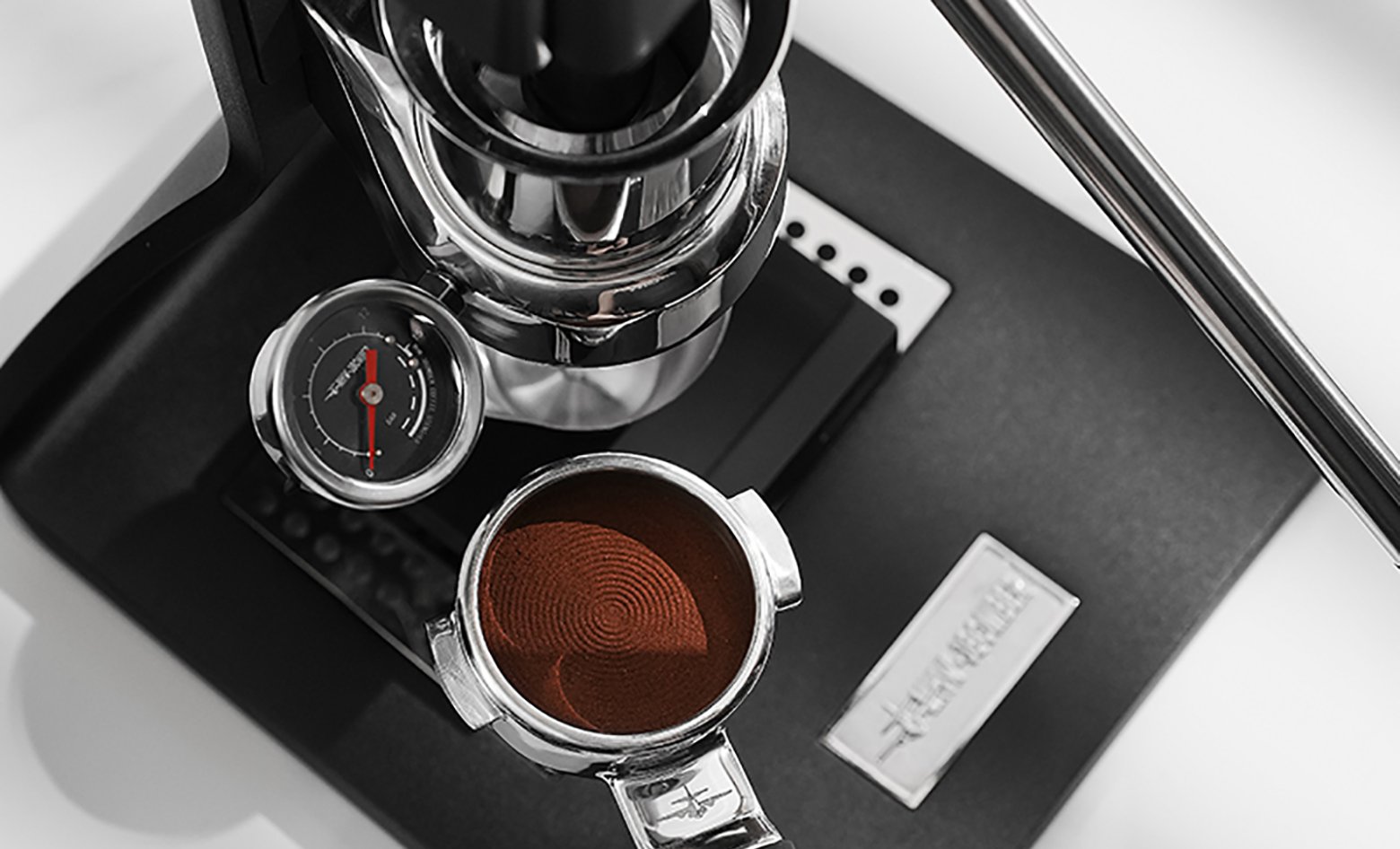
A maximum pump pressure tells you what the pump can deliver. The number does not tell you how good your espresso will be. For that, look at the pressure during brewing, how water flows through the coffee and what ultimately ends up in your cup.
What does pressure do when brewing espresso?
With espresso, hot water flows under pressure through a layer of finely ground, tamped coffee. This coffee bed is also called the puck. As water passes through it, it takes up soluble flavour compounds. We call this extraction.
The coffee resists the water. A finer grind generally makes the passages between particles smaller. A coarser grind lets water through more easily. The pump, the coffee's resistance and the machine's construction together determine how pressure and flow develop during brewing.
Maximum pump pressure and brewing pressure are different figures
A stated 20 bar may describe the maximum pump pressure. This differs from the pressure at which water acts on the coffee bed during a brew.
- Maximum pump pressure: the maximum the pump can build under certain conditions.
- Brewing or extraction pressure: the pressure during brewing. This depends on the machine, resistance in the system and where you measure.
A machine with a maximum pump pressure of 20 bar can therefore brew espresso at a lower pressure. You cannot directly compare one machine's pump maximum with another's extraction pressure.
The measurement location also matters with a pressure gauge. Pressure at the pump need not equal pressure at the coffee bed. Read the explanation of pressure and measurement points.
Why is around 9 bar common?
Around 9 bar is a widely used starting point for traditional espresso. La Marzocco also sets its machines to this pressure. With a suitable grind, dose and preparation, it can produce a concentrated espresso.
But 9 bar does not guarantee a delicious cup. An uneven coffee bed remains uneven at 9 bar too. And a different coffee or recipe may work well at lower pressure. La Marzocco also describes brewing at 6 bar, for example. Read more about brewing espresso at 6 and 9 bar.
Why can extra pressure work against you?
It seems logical that pumping harder delivers more flavour. But ground coffee changes under pressure.
Extra pressure can compress the coffee bed further. The space between particles becomes smaller and resistance increases. This can actually reduce the amount of water flowing through the coffee per second. You pump harder but get less flow. How strong this effect is depends partly on the grind and how the coffee is packed. See the research into the permeability of ground coffee.
The water also needs to reach the coffee evenly. With clumps or uneven distribution, it may mainly follow a few easier routes. This is called channeling. Some areas are then extracted more than others. More pressure does not fix uneven distribution. Read more about channeling and coffee preparation.
This makes 20 or 22 bar an illogical general target for espresso. It does not mean that every brew above 9 bar automatically becomes bitter. Pressure, flow, contact time and flavour are connected. One number does not explain the entire brew.
What can you adjust yourself?
With espresso made from ground coffee, repeatable technique gives you more control over brewing. Start with the same coffee and dose. Then change one thing at a time and taste its effect.
Grind size. A finer grind generally creates more resistance and slower flow. A coarser grind usually does the opposite. If the espresso barely flows, grinding slightly coarser may help.
Dose. The amount of coffee affects the thickness and resistance of the bed. Use a dose suited to your filter basket and weigh it. This gives successive brews the same basis for comparison.
Distribution. Break up clumps and distribute the coffee evenly before tamping. This reduces differences in resistance within the coffee bed.
Tamping. Tamp straight down and consistently. Adjust the flow through your grind, so you do not need to tamp differently for every espresso.
Water, temperature and beans. These also affect extraction and flavour. A pressure figure tells you nothing about bean freshness or how well the chosen temperature suits your coffee.
What if your espresso has little crema?
Little crema does not automatically mean your machine provides too little pressure. Crema also depends on the beans and the carbon dioxide present in coffee after roasting. Older coffee may therefore produce less crema.
Look at freshness, flow and especially flavour before grinding finer. A thick crema layer is not proof of good extraction on its own. Read more about freshness and crema.
How does this apply to Cera+?
Pressure figures deserve explanation for our own machines too. For Ceramax, we state a maximum pump pressure of 20 bar and an extraction pressure of around 9 bar. These are different specifications. The maximum pump pressure is not a promise of better flavour.
The practical options are more interesting for your preparation. With the bottomless 58 mm portafilter, you prepare 18-20 grams of ground coffee and can see how the espresso flows. This lets you adjust the grind and preparation based on what you see and taste. You do need a suitable espresso grinder.
What should you look for when choosing an espresso machine?
When a pressure figure stands out, first ask exactly what it means. Then consider whether the machine suits the coffee you want to use and how much you want to adjust yourself. Think about a suitable filter basket, temperature control and options for repeating or adjusting your preparation.
You want to know how the machine helps you make delicious espresso. The highest number on the box does not answer that yet.
